Team Group Photography Melbourne: Background Ideas That Stand Out
If you have ever tried to wrangle a full sports squad into one frame, you already know the real challenge is not the camera. It is the space, the light, and the background that either helps the group look sharp and cohesive or steals attention from the people who should be the focus.
In Melbourne, where changeable weather and strong daylight can both work against you, the background becomes more than an aesthetic choice. It is part of the workflow. It affects how easily players can move, how the uniforms read on camera, and how consistently you can deliver clean team group photos across age groups, competitions, and venues.
Below are background ideas that stand out for team group photography, plus the practical trade-offs I keep in mind when working with sports teams across Melbourne.
Start with what the background must achieve
A background should do three jobs well, ideally at the same time.
First, it has to support readability. When you photograph a team, the audience typically wants to see faces, kit colours, and numbers. If the background is busy or high contrast, those elements compete. The result is that the group looks “busy,” even if everyone is perfectly posed.
Second, it should make skin tones and uniform colours look honest. Melbourne’s sky can swing from bright to overcast quickly, and different surfaces can cast different colour shifts. A background that looks great to the eye can still skew whites and skin tones once it hits your sensor.
Third, it should be efficient. Sports team photos Melbourne clients often want a set: formal group shot, a secondary group shot, maybe an awards photo, and sometimes a sponsor-friendly version. Background choices that slow you down, require constant flagging, or force awkward posing cost time and increase the chance someone gets cut off, blinked, or half-turned.
When I plan Team Group Photography Melbourne sessions, I treat the background like another team member. It needs to show up, behave, and not complicate the job.
Weather-proof background ideas that look premium
1) Clean architecture walls (with depth, not clutter)
A solid wall or building façade can look surprisingly “designer” when you pick the right texture and placement. The trick is not just finding a plain surface, but selecting one that gives you depth cues without visual noise.
A light-toned wall works well for most team colours, especially for dark uniforms where you want separation. If your kit is already light, you can switch to a mid-tone or darker background for contrast. The best walls have minimal signage, no parked cars intruding, and enough space for the group to stand without leaning into the background and losing dimension.
Practical note: watch for reflections from nearby glass or polished surfaces. You might think you have an uncluttered wall, then notice a flicker of bright light across someone’s helmet visor or the front of a jersey.
This approach is ideal for Melbourne Sports Team Photography where you want consistency across multiple teams using the same venue.
2) Outdoor shade with a controlled look
Shade is a lifesaver in Melbourne, and it can also be a stylistic choice. If you find a spot under a verandah, near a covered walkway, or beside a grandstand edge, you can keep lighting even across everyone’s faces.
Shade backgrounds tend to look smoother on camera. Faces hold detail, and you avoid the “squint and shine” problem that comes with hard sun. The trade-off is that shade can flatten the image if the background becomes too dark. A mid-grey or softly lit wall behind the group often gives Go to this site you the best balance.
For Sports Team Photographer Melbourne assignments, this is a reliable option when you need predictable results within tight time windows.
3) Natural greens, framed like a portrait
Parks, ovals with landscaped edges, and garden borders can provide a clean natural look, but they must be controlled. Too much greenery can turn into a patchwork of distracting colours, especially if there are flowers or bright signage.
Look for areas where the greenery is continuous and evenly lit. That gives you a background that feels organic but not busy. If you can position the team so the background falls out of focus, you get a professional “portrait” feel without turning it into a generic outdoor snapshot.
One practical trick: avoid placing players directly against tall shrubs. Leaves can catch on uniforms, and when people shift, you may lose parts of shoulders and arms. Also check that no branches create “fence lines” across faces.
4) Stadium or grandstand gradients
Sports League Photography Melbourne often benefits from a stadium background because it instantly signals context. Rows of seats, railings, and structural lines can add energy while still supporting the group.
The key is angle. If you shoot straight into a crowd of seats, the background can become a wall of repeated shapes. Instead, aim so the lines recede behind the group, creating a gradient effect. This makes the team feel anchored and keeps attention on the players.
If the stadium is brightly lit, pay attention to the direction of light. Backlit seats can produce a rim-light on the edges, but it can also blow out highlights. In Melbourne, where cloud cover can shift in minutes, you may need to recheck exposure as teams rotate in and out.
5) Textural surfaces: brick, timber, and industrial walls
Brick walls and timber fences can add character to team group photos without overwhelming the subject, as long as you keep the frame tidy. Industrial textures work especially well for clubs that lean into a modern identity.
Choose surfaces with a consistent tone. Mixed-colour graffiti or a patchwork of repairs usually reads messy. If you are photographing across multiple squads, you want a background that looks consistent from one game day to another, not something you only love under specific conditions.
The best use of textured surfaces is often for secondary team photos, like an action-shot style group where you want personality rather than formal uniformality.
Backgrounds that create “instant story” for sports clubs
Some backgrounds do not just look good, they tell people where the team belongs. That matters for community clubs and for squads photographed over a season, where the club identity builds over time.
Club signage and sponsor walls (with careful distance)
Sponsor boards can be tempting because they show “official” branding. The risk is that signage can dominate attention, especially if it includes multiple logos, bright colours, or small text that becomes unreadable blur.
If you do use sponsor signage, distance is your friend. Place the group far enough that the text falls into soft shapes while remaining recognisable as branding. You can also frame tighter so the team remains the largest element. For many clients, this becomes a perfect option for a team photo that they will print on club social pages or use internally.
Trade-off: if you position too far, you may need more light or a higher ISO to keep shutter speed up, especially for groups that are moving around while you call them into place.
Pathways and fence lines for controlled dynamism
A boundary fence, a walkway, or the edge of an oval can add a dynamic sense of direction. These backgrounds work best when you find a clear line that leads behind the group, rather than a cluttered pattern of posts and cables.
Avoid fence backgrounds with bright interruptions that repeat across the frame, like alternating reflective panels. They can create visual flicker. If you can, choose a segment with consistent materials and a clean view.
This is often a great option when you photograph at Sports Team Photos Melbourne venues and need something that works regardless of weather.
The light and lens choices that make backgrounds behave
Background ideas are only half the story. A good background under the wrong light can look harsh or distracting, and a “boring” background can become stunning if exposure and depth are right.
When I’m photographing a team group, I usually aim for enough subject sharpness so everyone’s eyes and faces hold detail. That means you cannot simply rely on blur to hide everything. You still need to choose a background that looks good even at moderate depth.
If the background is busy, you can reduce its impact by choosing a wider aperture than you would for a fully landscape shot, but you also have to consider how many rows of players you have. Three rows in particular can become unforgiving, because shallow depth of field can soften faces in the back row.
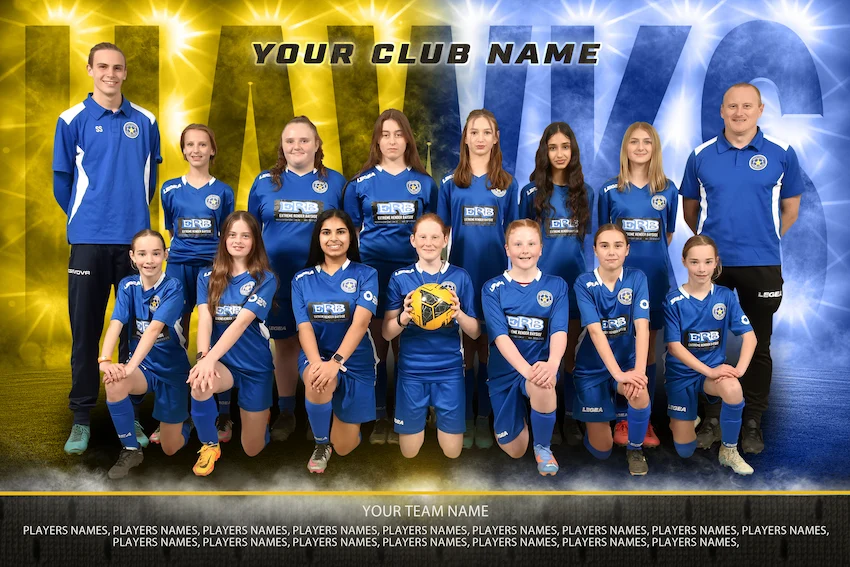
Also, keep an eye on highlights. Uniforms often have glossy elements like sponsor tape, trims, or reflective numbers. If the background is bright, it can push exposure so highlights clip. That is when you get washed jerseys that lose their proper colour.
In Melbourne, cloud cover is a frequent ally. Overcast skies tend to make backgrounds look more even and flatter, which can improve skin tones and make kits look truer. Direct sun can be great for stadium gradients and dramatic texture, but it needs planning, especially with large groups.
Backgrounds by team type and uniform colour
Different sports and team kits “behave” differently under the same background.
A team with very dark uniforms often looks best against lighter walls or grassy backgrounds, because you get separation without relying on heavy post-processing. Teams in light-coloured kits can handle mid-tone backgrounds well, but can struggle against very pale walls where the jersey blends into the background. In those cases, you may prefer shaded architecture or a darker fence line.
For Melbourne Sports Team Photography across multiple age levels, you also have to account for accessories. Goalkeepers may wear darker gloves or reflective details. Some teams have hoods, warm-ups, and training layers that change colour blocks. A background that is perfect for one uniform might not be ideal for another within the same session.
I sometimes do this by planning two background options in the same location: one “safe” background for crisp group readability, and one “character” background if the team has time for a second pose.
A small planning routine that saves minutes on game day
Time is usually the real constraint, not creative options. If a coach has a strict schedule, you cannot test five backgrounds while the rest of the field is warming up.
Here is a short routine that keeps background decisions grounded and fast.
- Confirm the final image use: club website, social media, print banner, or sponsor wall
- Pick one primary background and one backup in the same area
- Check background distractions at player eye height, not from the ground
- Test one frame with the exact group size you expect, then adjust placement
- Keep a quick note of light direction, so you do not fight exposure between sets
This kind of approach is what makes Sports League Photography Melbourne deliveries feel smooth, especially when teams rotate quickly between games.
Common background problems, and how to avoid them
You can have a great venue and still end up with a background that ruins the photo.
One common issue is “headroom chaos.” Some locations look spacious until you place tall players on the left or right and realise a pole, tree branch, or overhanging sign cuts through the frame. Another issue is the background becoming a character nobody asked for, like an obvious poster or a bright car parked behind the group.
Then there is the human factor. If the background demands that players stand in a way that feels unnatural, they will start shifting. Shifts create gaps between rows and make it harder to keep everyone in focus.
A second tricky problem is colour contamination. Certain surfaces can reflect colour onto uniforms. If you have a team in red, and the background is a deep green fence, you might see unwanted colour bounce on sleeves or collars. It might not be dramatic to the eye, but it shows up in the final image.
For Sports Team Photographer Melbourne work, I treat these as scouting issues, not surprises. A quick background check before the team steps in prevents a lot of re-shoot requests.
Background ideas that can look bold, without getting risky
If you want backgrounds that stand out beyond the typical oval and plain wall options, you can push a little, as long as the team stays readable.
A dark brick wall with a soft light can look dramatic and modern. A mural wall can add personality, but only if the mural has a coherent colour palette and you can frame so faces stay clear. A row of Sports League Photography Melbourne tall trees can create a tunnel effect, but if leaves flicker in the breeze, you will get inconsistent highlights across frames.
When you choose a bold background, you are also choosing a higher tolerance requirement. The team has to stand still, clothing needs to be tidy, and you need to control the angle so no distracting elements appear around heads and shoulders.
If you want that bold feel, I usually recommend using it as a second shot. Get the primary group on a clean background first, then move to the creative set once everyone is settled.
How I’d choose backgrounds for a typical club session
Imagine you are photographing a club that has multiple teams across an oval. Some squads are arriving early, others are late, and the weather might change between warm-up and presentation time.
A workable approach is to reserve the cleanest background for the “must get it right” group. Then use the more atmospheric background for the optional second pose.
That might look like this in practice. You start with a controlled architecture wall or a shaded area to get crisp faces and consistent colours. Then, once you have the formal shots, you move the team to a stadium gradient, greenery edge, or textured industrial wall for a more distinctive look.
This is also helpful for team yearbooks or season wrap photos. A consistent primary background creates uniformity across teams, while the creative backgrounds give each squad a little signature identity.
Two quick examples of background placement that make a difference
I have photographed groups where the exact same location produced two totally different results, simply because of placement.
In one situation, the team originally stood too close to a fence. The fence created a repeated line right behind faces, which made the image look segmented. When I moved them forward by a few steps and widened the angle slightly, the fence turned into a softer texture instead of a pattern. It felt like the image “opened up.”
In another case, the team wanted a mural background. It looked fantastic to the eye, but in the first test frame the mural elements landed behind people’s heads, making the image feel chaotic. We solved it by changing the camera height and shifting the team position so the mural contributed colour blocks rather than random shapes.
Those adjustments are often small. The difference is you are making the background serve the group, not compete with them.
What to ask your client before you scout
If you are booking a Sports Team Photographer Melbourne session or working as the club organizer, asking a few targeted questions early prevents the wrong background from taking over the shoot.
What matters most is how the team expects to use the image. A coach might want something “award-ready,” while a sponsor might want a version that keeps branding readable. A team manager may plan a social post and a printed sheet for players to take home. Each use case changes what “stand out” means.
Here is a short set of questions I find useful because the answers guide background selection quickly.
- Where will the photo be used, and at what size?
- Do you need sponsor visibility, or is the priority faces and uniforms?
- How many rows of players are likely in the group?
- Are there any items that must stay out of frame, like signage or parked cars?
- What does the club identity lean toward, traditional formal or modern bold?
When those answers are clear, background ideas stop being random. They become a deliberate choice.
Delivering consistent results across teams and seasons
Melbourne clubs often photograph multiple teams in one day, and sometimes multiple age groups across a season. That is why background consistency matters even when you vary the look.
I usually aim for a reliable “core” set of backgrounds that I can recreate at different venues. Then I tweak based on the kit colours, the group size, and the light direction. When clients hire a Sports Team Photography Melbourne provider, they are not only paying for the act of photographing. They are paying for predictability, especially when the session includes nerves, kids moving around, and adults coordinating quickly.
Backgrounds that stand out are fantastic, but the real value comes when you still deliver clean, flattering, usable images even if the weather shifts or players arrive with uneven spacing.
That is where good judgment matters. A background can be creative, but it has to be practical enough to work on real game days, not just perfect conditions.
Final thoughts: choosing a background that elevates the whole team
Team group photography is one of those areas where the details reveal professionalism. The right background turns a group photo from “we were there” into a lasting club piece players want to keep.
If you are planning Sports Team Photos Melbourne for a club, give thought to backgrounds that are simple enough to keep focus on faces, but interesting enough to feel like the photo has intention. Clean architecture, controlled shade, stadium gradients, and well-chosen greenery can all look premium when light and distance are handled properly.
And if you want a little extra flair, use bold textures or characterful surfaces as a second set, after you nail the primary image. That way, you get standout results without risking the shot everyone needs most.
Whether you are photographing a single team or running multiple squads in one day, the best background is the one that helps the players look their best and makes the final images easy to share, print, and remember, season after season.
Pure Sport Images
23 Grandview Ave, Mulgrave VIC 3170, Australia
+61 413 157 614
[email protected]
Website: https://puresportimages.com.au